Understanding the Starborn
Eighty years of remote observation, supplemented by recent fieldwork, have revealed a remarkably complex celestial lifeform. Much about their existence remains beyond the reach of conventional biology—and beyond the evidence presently available to us.
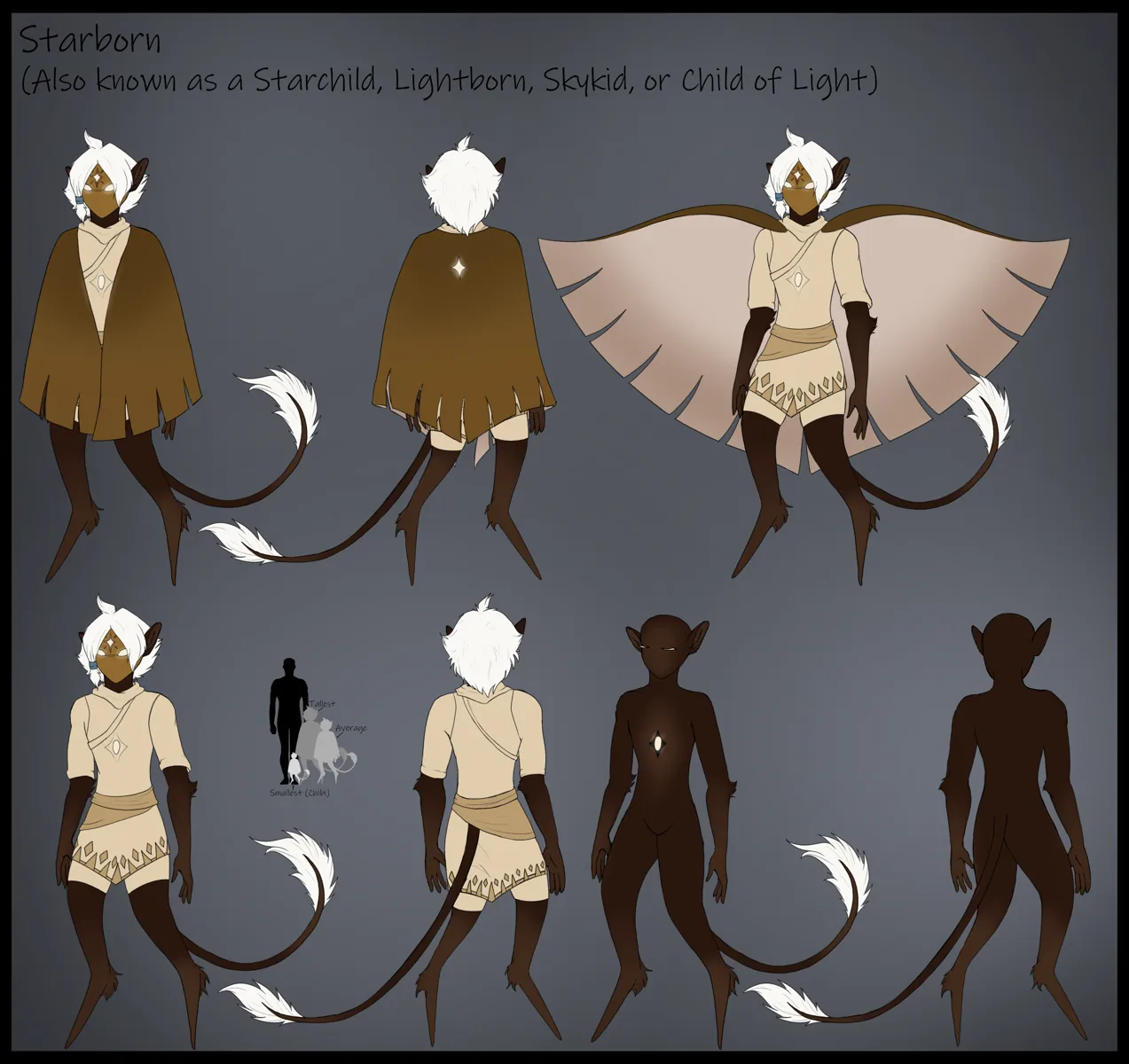
What we can establish
Starborn are small, luminous, apparently ageless inhabitants of the Realms. Their resemblance to the former inhabitants depicted in ruins is striking, but it would be premature to identify them as a surviving population of that civilization.
Field records show individually recognizable beings with distinctive masks, capes, bodily markings, and patterns of behavior. They fly by means of cape-like structures, gather energy from luminous sources, interact frequently with others of their kind, and occupy shelters within ruined buildings. The present population includes newly appeared individuals and considerably more experienced ones; appearance and size do not reliably indicate which is which.
The term starborn is the program’s working designation. Informal names used in historical field reports include starchildren and children of light. Their internal structure and origin remain under investigation.
A body unlike a conventional organism
Across many years of camera records, starborn consistently display a similar basic body plan: a relatively small upright frame, two arms, two slender legs terminating in pointed feet, mobile ears, a long expressive tail usually ending in a pale tuft, and a face covered by a mask. Their feet do not display visible toes, claws, or hooves. A luminous region at the chest is particularly conspicuous when the individual is weakened, excited, or exchanging light with another.
Despite a somewhat youthful silhouette, starborn maintain proportions and movement patterns unlike those of human children. Body and garment boundaries are not always distinct in recordings: individuals can alter the shape or coloration of their clothing-like surfaces over time, sometimes dramatically. Hair generally appears pale or white; vessels display a broader range of earthy tones, including brown, reddish, and very dark coloration. Patterns and markings on exposed surfaces sometimes remain recognizable across substantial changes in presentation.
Clinical contact has been exceedingly limited. During necessary emergency care, researchers found that the external surface can behave more like a warm, resilient mineral or ceramic-like material than ordinary skin. This is a descriptive comparison, not a confirmed chemical classification. The precise composition of the vessel, its energy requirements, and the distinction between a starborn’s body and its manifested attire remain unknown.
Light, capes, and flight
Light is central to starborn activity. Individuals approach luminous sources, linger near active shrines, and appear to recover strength after sustained exposure. Close association with another starborn, accompanied by resonant calls, can also coincide with renewed luminosity. Some individuals gather scattered points of light, while others visibly expend their own reserves during strenuous travel or in hazardous environments.
The cape functions as a flight surface, enabling controlled gliding and bursts of powered movement. Markings on its back occur in repeatable arrangements and are strongly associated with differences in flight endurance. Researchers therefore use the count of visible cape marks as a practical field descriptor, not as an exact measurement of age. Up to fifteen marks have been documented, although individuals bearing the highest counts are exceptionally uncommon. Strong flyers routinely alternate short powered movements with extended gliding, apparently conserving energy.
Newly formed individuals may initially lack a cape; later appearance of the cape often coincides with their first sustained flight. In records of one unusual capeless individual, the absence of powered flight did not prevent long-term survival. Our understanding of such variants is preliminary.
Arrival, learning, and apparent maturity
Remote recordings include events in which a bright descending object strikes the ground with a resonant flash, followed by the appearance of a small starborn. Not every event appears to produce a surviving individual. One such formation was directly witnessed by a member of the field team, strengthening the link between these descents and the arrival of new starborn. The physical and energetic processes responsible have not been established.
New arrivals typically display hesitant movement, simple clothing-like features, little or no flight ability, and pronounced attention to sources of light. They are often assisted by more experienced starborn, whose guidance appears to improve their prospects in hazardous terrain. Older or more experienced individuals commonly demonstrate far greater navigational skill, expressive control of their appearance, and familiarity with safe routes.
For consistency across records, the program uses provisional developmental labels based chiefly on observed experience and cape marks:
| Field designation | Indicators in observation |
|---|---|
| Spark | Recently formed, little flight capacity, often reliant on safe shrines or experienced companions. |
| Ember | Greater mobility and several cape marks; exploratory, but still comparatively vulnerable. |
| Renascent | Usually nine or more marks; designation provisionally associated with individuals believed to have returned from an Eden journey. |
| Ascendant | Twelve or more marks; typically accomplished flyers and frequent guides. Fifteen-marked individuals are exceptionally rare. |
These labels are analytical conveniences used by the research program. They should not be understood as confirmed native social categories or measures of chronological age.
Shrines, nests, and safe routes
Starborn regularly gather at illuminated structures known to the program as starfire shrines. These places function as social meeting points, places of rest, and apparent energy refuges. Some shrines are highly active while others appear dormant. On rare occasions, starborn have been recorded restoring activity to a darkened shrine; these events appear to require an energetic contribution from the individual.
Individuals often shelter in intact rooms, recesses, and protected spaces within older ruins. Such sites may contain arrangements of collected objects and luminous items. Observations suggest recurring occupancy of particular shelters, sometimes by the same recognizable starborn, but do not establish a formal system of ownership. Movement between ruins, shrines, and areas of scattered light produces fairly regular travel corridors, although routes change in response to environmental hazards.
Our field station lies close to an active shrine, providing an unusually rich—but geographically narrow—window on the species. Station personnel minimize disruption, avoid blocking passage, and do not attempt to follow starborn into private shelters.
Injury, darkness, and mortality
Starborn encounter significant risks. Long-term monitoring documents losses associated with predatory dark creatures, including large creatures field teams call krill, as well as attacks by smaller crab-like animals. Falls, depletion of light, and exposure to contaminated areas may also result in apparent injury or death. Newly formed and less experienced individuals are particularly vulnerable.
Visible damage commonly includes surface scuffing or cracks, diminished luminosity, slowed movement, and unusual rigidity. In some cases, dark crystalline deposits form on affected regions. Severely affected individuals may exhibit a cold-looking dark discharge near the mask, followed by abrupt luminous surges and expulsion of dark material. These signs are consistent with an energetic contamination process, but its underlying mechanism remains uncertain.
Recovery is sometimes observed after prolonged rest near a strong light source or sustained assistance from companions. In a limited number of emergency cases, medical staff have intervened when the immediate threat to life outweighed the disruption caused by human contact. Not all interventions have been successful. The program does not treat starborn as suitable subjects for routine capture or clinical procedures.
The journey to Eden
A striking number of starborn travel toward the mountainous region known as Eden, sometimes accompanied by more experienced companions. Many do not appear again within the observation network. Records from a discontinued tracking study indicate that some individuals last registered near the summit, yet were subsequently identified elsewhere by stable physical features or other consistent characteristics, sometimes with fewer visible cape marks than before.
One working hypothesis is that a process occurring beyond a particular point in Eden allows at least some starborn to return after an apparently terminal event. The available evidence does not demonstrate death, a mechanism of rebirth, or whether every returned individual underwent the same process. The relevant summit environment is not directly accessible to our current instrumentation, and the starborn themselves have not provided an explanatory account.
The phenomenon is consequential enough to remain a major research priority, but it would be scientifically irresponsible to describe the proposed cycle as established fact.
Working hypothesis: continuity after Eden
Evidence: Repeated last-known movements toward the summit; subsequent identification of individuals believed lost; changes in cape-mark count across observations.
Alternative explanations: Incomplete tracking, limitations in individual identification, poorly understood changes in form, and unobserved pathways of return.
Status: Open. Further conclusions depend on nonintrusive longitudinal evidence.
How we know what we know
Approximately eight decades of distributed, remotely operated cameras form the core of our historical dataset. Contemporary work adds direct but generally distant observation near the field station, artifact and environmental study, and carefully documented voluntary encounters. Camera evidence is strong for movement and visible behavior, but weak for internal sensations, beliefs, and processes occurring outside recorded space. Our interpretations distinguish these limitations wherever possible.
An early wrist-band tracking project operated for roughly five years and ended approximately three decades ago. Although it contributed movement and survival information, the project was discontinued once starborn demonstrated the ability to remove and store the bands, and the team reassessed earlier assumptions about their cognition. The program now relies on nonintrusive observation and voluntary interaction rather than routine restraint or tagging.
Our commitment is to preserve the natural lives of the Realms’ inhabitants, not simply to acquire information about them. We do not disclose sensitive nest locations or promote visitor access to restricted field sites. Our public reports are revised as evidence improves, including when new findings contradict longstanding interpretations.
Prepared as a public overview by the Realms Research Program, Andrion Fantastical Creature Research and Rehabilitation Center. See also the observed individuals field guide and the research divisions.
Social beings, sophisticated communication
Starborn frequently travel in loose groups, rest together, follow familiar companions, and engage in what appear to be games. Carrying, playful pursuit, and physical closeness are common. Experienced individuals have repeatedly been recorded guiding inexperienced ones through unfamiliar or dangerous spaces. Many behaviors once dismissed as simple mimicry now suggest flexible social understanding and substantial learning capacity.
Audible calls are musical or resonant rather than articulated human speech. Nevertheless, changes in pitch, rhythm, posture, ear position, tail motion, and cape movement appear to communicate a wide range of states. Upright ears and an active tail commonly accompany attentive exploration; lowered ears, rigid postures, sharp calls, and forceful cape movements may accompany distress or confrontation. These interpretations depend on repeated context, and should not be mistaken for a complete translation.
Starborn also sometimes expose or bring forward a concentrated light near the chest while engaging with another. Such exchanges are followed on occasion by immediate coordinated behavior, raising the possibility of information transfer beyond sound and gesture. The nature of this process is not yet understood. We have also documented disagreements between recognizable individuals, including recurring confrontations and occasional pushing, kicking, and cape-flapping; a generally sociable species is not necessarily conflict-free.
Our station has maintained sustained, voluntary, two-way interaction with one known individual, Varadi. This contact has provided evidence of unusually rapid learning, recognition of human routines, and the capacity to use a human-operated communication device. Other starborn may approach, observe, or tolerate researchers without engaging in comparable communication. Claims about the knowledge or motives of the wider population must therefore remain tentative.